1. Not a Child’s. A Soldier’s
Cement (life-size combat boot)
25 x 11 x 29 cm
2. Remains. A Skull
Fiberglass (life-size skull)
20 x 14 x 19 cm
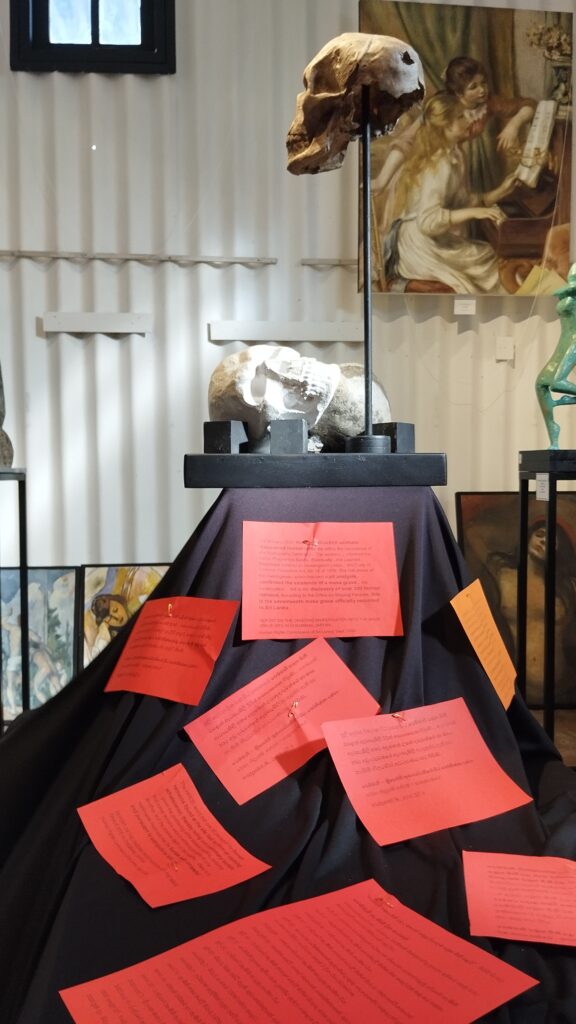
3. Never meant to be. Found.
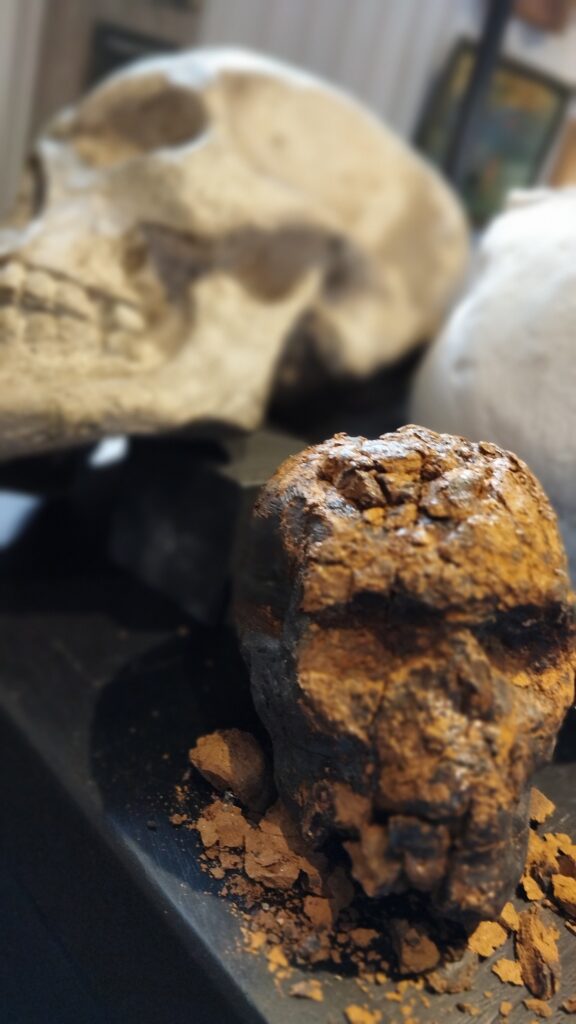
Dolomite, cement, plaster of Paris (life-size skulls); unfired clay (half-size skull, crumbling)
60 x 37 x 37
I have always been drawn to the image and the word. In recent years, sculpture has offered me a third language—one of form, space, and endless perspective. It has been a deeply grounding experience.
When I first started working with sculpture, I was stuck for a moment trying to figure how to manage depth. It seemed beyond me. How does one go beyond the two-dimensional surface and build a third perspective which can be ‘read’ from myriad different angles? Our conditioning to simply work on one surface was hard to break. In fact the first pieces I created felt slightly flat when I remembered (not too often!) to check from other angles. This aspect that introduces depth and volume was also the attraction, as I got used to working on sculpture.
Working at various points with slab work, building with rolled clay, and then trying to recreate from a given object has had its moments of wonder and challenges.
When I worked with the soldier’s boot, getting the measurements right and creating the basic design from it was the least challenging elements. The hardest part was capturing the feel of the leather surface and lacing the boot tidily. And then weaving in the wear and tear. Sculpting by observation and engaging with the original material, to recreate in clay, and then, in the case of the boot, with cement as the medium to conclude with. I felt the bulge of the toe box and the various seams that separate the parts (vamp, tongue, backstay, heel counter). A human-made object is still an item that has a neatness which is achievable, governing principles which are neat and tidy.
Engaging with a skull as the point of origination, has its own hardships. Working with the skull means working with nature itself — its logic, its proportions, its relentless intelligence. The design is exhilarating, a thrill to discover.
Observing the key elements of a human skull – the pyramid-shaped cavity of the eye socket, the curving ear canal, the neat positioning of the mandible to move the jaw and lower mouth. Then my own detective work on skulls: reading up on decay, learning to guess age from development and exposure to the elements. Touching, feeling, tracing the fine bone structure, left me in awe.

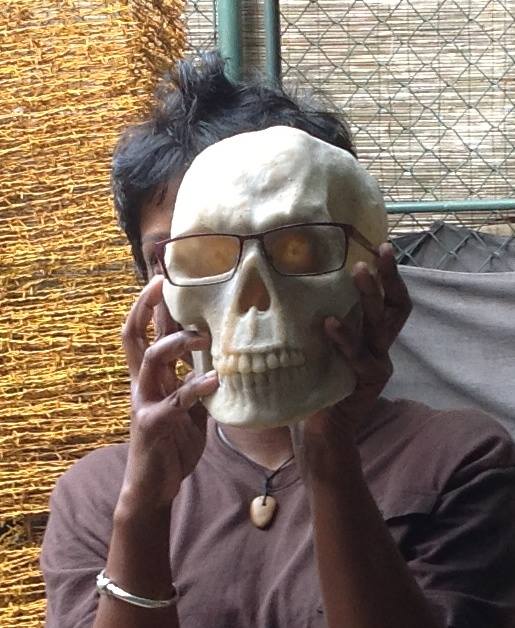
The sculpting of the skull was a pet project to occupy our personal library space. I also felt the need to create more than one, to experiment with different material and how they lend themselves to this re-creation process. However as I was making the silicone mold, I also realized that this skull would occupy too much space on a bookshelf and therefore was not suitable for that original purpose I had in mind. (Hence the plan that germinated to create a half-size skull at a later point.)
The first skull I created through the mold was of plaster of Paris. A fine white skull which left some residue in the hand and on surfaces. The next was fiberglass. Although working with fiberglass felt dangerous with its capacity to disappear right into one’s hand if one decided to touch it with naked fingers, was not a comforting thought. However the lightweight end product was a marvel to behold. (I had to leave aside environmental concerns for this one.)
Next was a dolomite experiment – working with whatever excess material remained from someone else’s mixture, destined for waste if not used immediately. So I had a half-done piece: the facial structure completed, the back a hollow, porous void. But the void was as it should be, the skull is, after all, the fine casing for the human brain. Incomplete no doubt, but it held a truth about real life.
The final of the skull series was when I lost the mold during a re-location process. Many months later, the silicone mold was found in a decaying state. So the cement skull is a slightly deformed last use of that mold. The deformation is not noticeable at first glance, except that I know it’s there. And I cannot shy away from that truth.
In my skull experimentations, the plaster of Paris skull, the incomplete dolomite skull and the slightly disproportionate cement skull fit in together to talk of impermanence.
My next attempt at sculpture was to get back to the half-size skull that I promised myself, for a bookshelf in our personal library. I started on this but never completed it. I retained the original unfired clay skull, which was shedding its surface, but still standing.
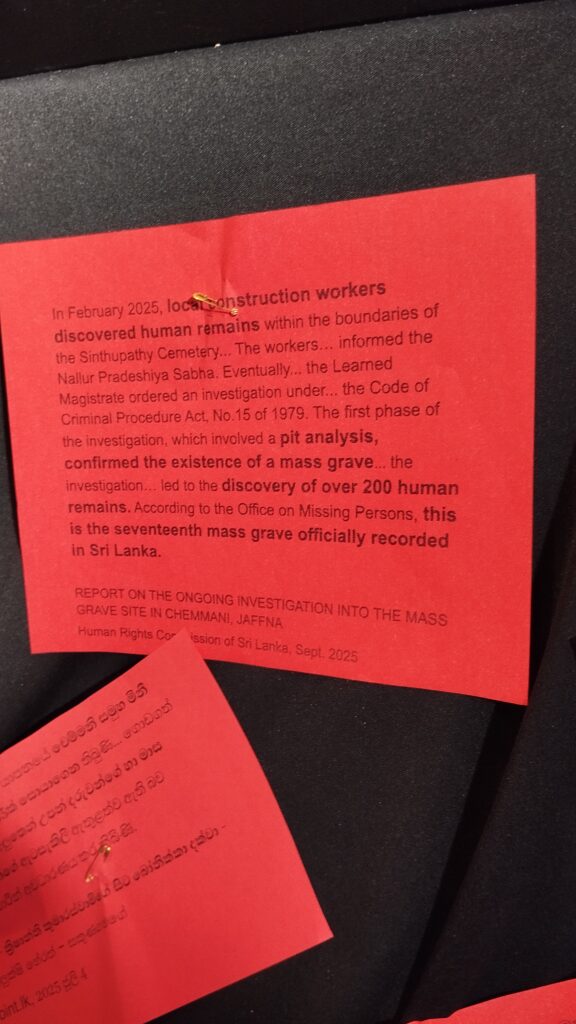
Each of these was done at different stages, as part of my exploration of material, form and size. As discussed, each carries its own element of undoing. Relooking at them now, in the context of today, what haunts my thinking is the Chemmani mass graves — alongside the many other mass graves Sri Lanka has been plagued with throughout our lifetime.
“Shallow. Unmarked. Buried alive. skeleton that was bound and blindfolded, showed evidence of assault and murder.” – several harrowing comments from mass media
This installation of skulls that are in various forms of decay and are otherwise undone, are in remembrance of Chemmani-Siththupaththi and so many other mass burials in the North and the South, in the East and West, and many other locations in between. Too many unmarked mass grave sites that were ‘Never meant to be. Found.’
My skull, the one I worked with, is not one of them. But I have worked in their shadow – a deep, dark shadow that lurks in our consciousness. The installation, ‘Never meant to be. Found.’ is my exploration of that consciousness. The other works, ‘Not a Child’s. A Soldier’s’ and ‘Remains. A Skull’ connect the dots through language.